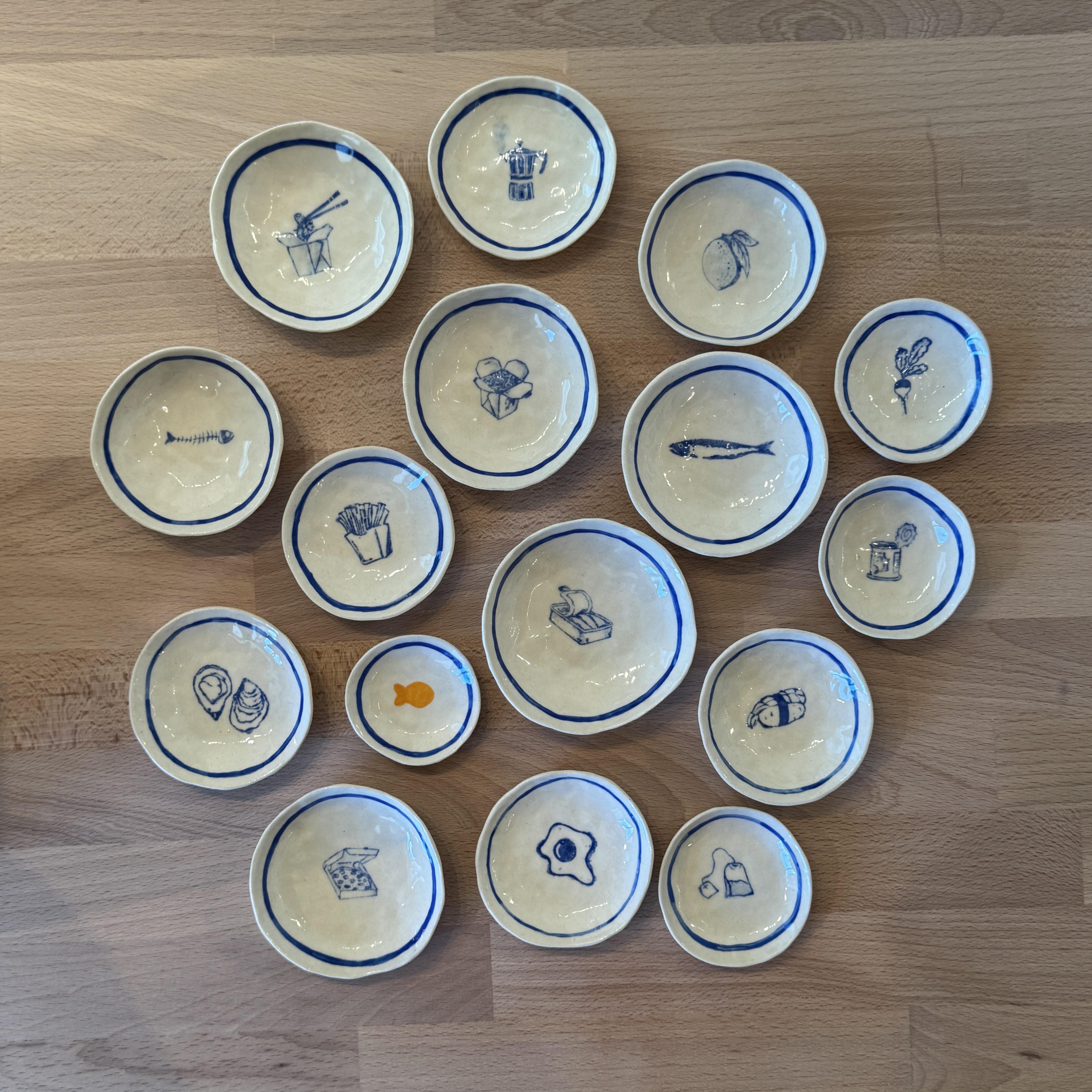
Monica Castillo, “FnB,” Ceramic
Nostalgia as a Souvenir Shop
Dayna J. Francois
I walk into the past like it’s a souvenir shop,
shelves stacked with postcards from memories
I don’t remember writing,
keychains jingling with the initials
of people I’ve loved
and the versions of me I’ve left behind.
There’s a snow globe of my first almost-kiss,
shaken just enough to blur the moment.
The glitter falls like the excuses I told myself
when I didn’t lean in.
I pick it up, feel its weight in my hands,
and think,
“Maybe this is what regret looks like:
beautiful in hindsight,
but impossible to hold forever.”
On the wall hangs a faded Polaroid
of my childhood bedroom,
Bible verses taped to the mirror,
closet doors locked tighter than secrets.
I wonder if I’d recognize the girl in that room now.
She prayed so hard to be someone else,
not knowing the version of herself she feared
would someday feel like home.
There’s a coffee mug labeled First Heartbreak,
cracked down the side but still holding water,
a metaphor I didn’t ask for but can’t unsee.
The handle is sticky with apologies
that were never owed to me,
and yet, I keep reaching for it,
a reminder that even bitterness
can sometimes taste sweet.
The register clerk has my mother’s smile,
her hands ringed with the gold of stories
she never got to finish telling me.
She offers me a discount on forgiveness,
but I’m not sure if it’s for her or for me.
I reach into my pocket,
only to find lint and lessons.
There’s a rack of T-shirts labeled
What Could Have Been.
I try one on for size,
but it doesn’t fit right.
Too tight in the shoulders,
too loose in the chest.
I take it off, hang it back up,
and let it stay there
for someone else to carry.
I wander toward the exit,
my hands full of trinkets:
a pressed penny labeled Lost Love,
a journal embossed with comp-het,
a magnet shaped like my old apartment,
still carrying the weight of unspoken goodbyes.
And as I step outside,
the sun hits me like a revelation:
nostalgia isn’t a home,
it’s a rest stop,
a place to pull over
and remind yourself of the journey.
I drop the souvenirs into a donation box,
leave the shop empty-handed
and full-hearted.
Because the past is a collection I can admire,
but the future is where I belong.
I Tell White Lies to Survive the Ride
Dayna J. Francois
I tell white lies to strangers
the way some people carry pepper spray
not because I expect danger,
but because I respect the possibility of it.
I tell white lies in rideshares,
in checkout lines,
to people who ask just enough questions
to earn a version of me
but not the whole archive.
My therapist says it’s self-preservation.
I say it’s efficiency.
Because explaining grief to a woman
who just asked where I’m from
feels like pulling a family album
out of a burning house
for someone who only wanted directions.
So when the Lyft driver asks about my life,
I give her the highlight reel:
school, ambition, education,
the kind of answers that fit
between red lights.
She is an elder Black woman
with a voice like Sunday dinner
and eyes that have seen
every version of America
pretend it was new.
She calls me baby.
She tells me she’s proud of me
before she knows enough to be.
And something in my chest recognizes her
as kin
not by blood,
but by survival.
So I tell her truths
with the sharp edges sanded down.
I am Haitian.
I am building something.
I am trying to make a future
that doesn’t eat me alive.
And when she asks about my mother,
I let the lie step forward gently,
like a coat I already know fits.
Because saying my mother is dead
changes the temperature of a conversation.
Because adoption turns small talk
into a dissertation.
Because I am tired
of holding strangers while they react
to my life.
We talk instead about Haiti,
about politics,
about 2018,
about the way instability moves
like a rumor that never leaves.
She tells me to take care of my people.
I tell her I try.
Both of us meaning
more than money.
We talk about teaching,
about legacy,
about how resistance
isn’t new.
It’s inherited.
History isn’t repeating itself, she says.
It’s rehearsing.
Same script, new lighting.
Same violence, now in HD.
We pull up to the airport
and she asks if she can hug me
the way aunties do
already holding you
before you answer.
She whispers into my ear
like she is passing down
a family recipe:
Baby, don’t tell people where you’re from right now.
Not everyone needs to know.
Protect yourself.
And suddenly
every white lie I’ve ever told
stands up and says,
See? I told you.
Because ICE is not just knocking
on immigrant doors.
It is rattling the idea
that citizenship equals safety.
Because families are being torn apart
and some of them look like mine.
Because some of them look like yours.
Because some of them thought
they were untouchable too.
Because being Black
has never required a passport
to be criminalized.
Because being queer
has always meant loving loudly
and hiding strategically.
I walk through TSA
with her words echoing
against my ribs.
I think about advocacy.
About microphones.
About how easy it is
to forget you are the headline
when you are holding the megaphone.
I forget sometimes
that I am not just speaking for the marginalized,
I am standing with them.
I am standing as them.
A Black woman.
A queer woman.
A Haitian-American woman
with a suitcase full of dreams
and a mouth trained
to measure safety before honesty.
I don’t stop telling my story.
I just learn
where to lower my voice.
Because survival isn’t silence,
it’s discernment.
Because community doesn’t mean
giving everything away.
Sometimes it means
an auntie’s hug,
a warning whispered,
and the wisdom to know
that not everyone deserves
your whole truth.
And maybe the white lies
were never lies at all.
Maybe they were prayers.
Monica Castillo, retired chef turned restaurant/hospitality consultant, enjoys working with independent businesses in the community to help them become more successful. She spends her off time in a ceramics studio at Phoenix College. Find Monica on Instagram @m_x_ceramics
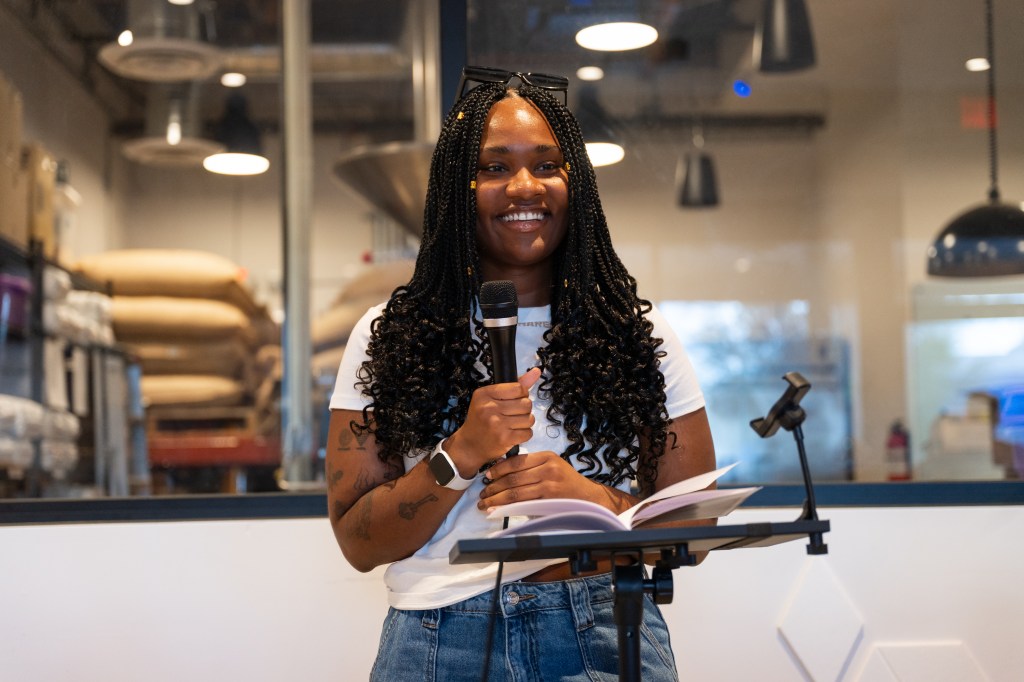
Dayna J. Francois is a Black queer writer, poet, educator, and podcast host whose work lives at the intersection of intimacy, identity, and emotional honesty. Her voice blends sharp cultural observation with lyrical vulnerability. Through essays, spoken word, and audio storytelling, she explores themes of queer desire, grief, attachment, faith, power, and the quiet moments that shape who we become.
Dayna is the creator and host of Stirring the Plot, a podcast and creative platform centered on queerness, storytelling, and doing things for the plot (intentionally, recklessly, and with heart). Her work holds space for messy sapphic love, navigating relationships, emotional growth, and the unlearning that follows survival. Whether on stage, on the mic, or on the page, she is deeply invested in telling the truth, even when it’s uncomfortable, unfinished, or still unfolding.
A Phoenix College alumna and emerging English educator, Dayna has a background in writing pedagogy, culturally responsive teaching, and trauma-informed practice. She approaches storytelling as both an art form and a tool for connection, healing, and liberation.
Dayna is currently working on essays, fiction, and long-form narrative projects. She believes in building your own narrative and daring to live inside it.
Find her on Instagram: @daynajfrancois and @stirringtheplotpod

